Completing the SAI FSA Questionnaire
If your Fieldprint Project has enabled the SAI Farm Sustainability Assessment (FSA) Equivalency Module, you will be asked to answer a 22-question survey about your farming operation. This article walks through where to find the questionnaire, how each question is structured, and what to expect. For background on what FSA is and why your project is using it, see SAI Platform Alignment.
Before you start
To complete the questionnaire, you need:
- At least one field with one crop interval finalized for the reporting year.
- At least one of those crop intervals associated with the Fieldprint Project requesting FSA performance.
- Documentation on hand for the practices the questions cover (see the tips throughout this article).
The questionnaire is at the farm level — you answer it once per farm per reporting year, not once per field.
Finding the questionnaire
The navigation steps below describe how a grower reaches the questionnaire.
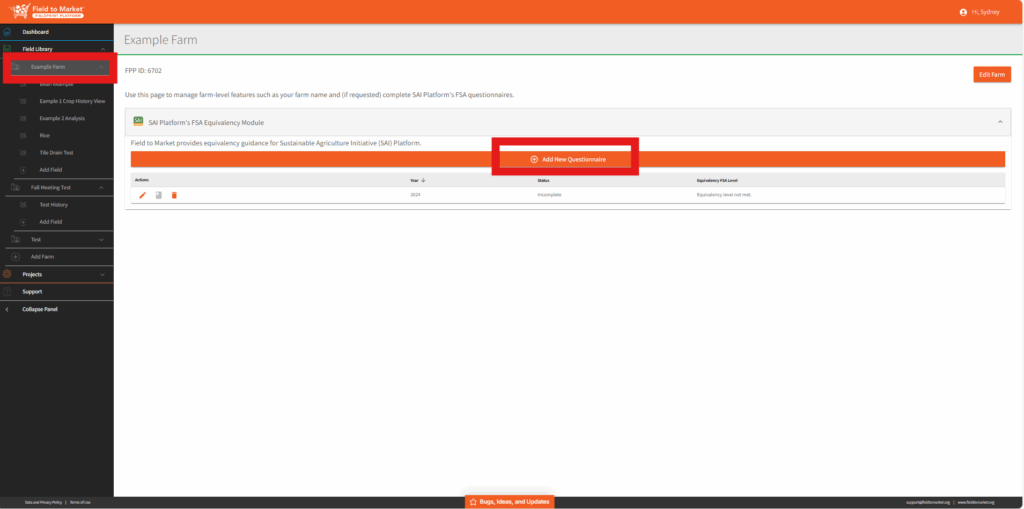
- Sign in to the Fieldprint Platform.
- Open the Field Library and select the farm enrolled in the FSA-enabled project.
- Open the questionnaire for that farm. The page title will read “[Reporting year] Questionnaire for [your farm name].”
If you are enrolled in more than one project and only some of them require FSA, the questionnaire will appear on each farm that is part of an FSA-enabled project. Each questionnaire is independent — an answer on one farm does not carry over to another.
How questions work
Each question is a short yes/no statement about your farming operation. Every question has a help icon next to it; tap the icon to see SAI Platform’s full guidance for that topic, including examples of the kind of evidence a verifier would expect.
There are three answer types across the 22 questions:
- Yes / No only. Used for questions that apply to every operation, such as compliance with laws, documentation of land rights, training, and recordkeeping.
- Yes / No / N/A. Used for questions about topics that may not apply to your farm. For example, Question 14 asks about irrigation planning; if you farm dryland only, the correct answer is N/A.
- Choose N/A when the topic genuinely does not apply to your operation — for example, N/A on the irrigation question for dryland farms, on the onsite worker housing question if no workers live on the farm, or on the minors question if no children live or work on the farm. Answering N/A is not a penalty; it tells the FSA system to exclude that question from scoring. Answering No when the correct answer is N/A will lower your result unnecessarily.
- Comments. Every question has an optional Comments box. Use it to note context, cite a document by name, or explain why you answered the way you did. Comments help verifiers during the verification step and are a good place to capture what you already do so you do not have to reconstruct it later.
Walkthrough — what each section covers
The 22 questions are presented in order. They fall into five broad topic areas. Your answers are saved as you go, so you can leave and come back. The sections below show the screens you will see and highlight what to watch for.
Questions 1–5: Compliance, documentation, and environmental assessment
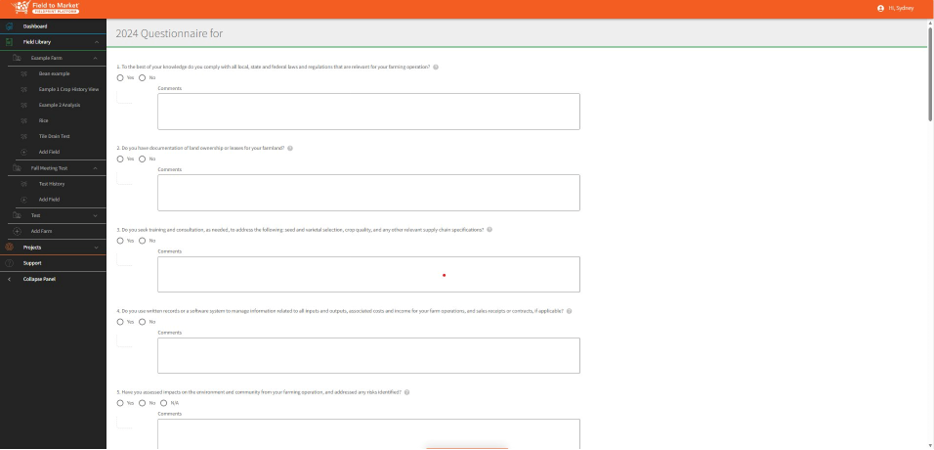
- Q1 Compliance with laws. The single most important question on the module. Yes here means you comply, to the best of your knowledge, with local, state, and federal laws relevant to your operation. Staying current through trade publications, cooperative updates, or crop advisors counts.
- Q2 Land rights documentation. Deeds, lease agreements, or customary-rights documentation are what verifiers look for.
- Q3 Training and consultation. Covers seed and varietal choices, crop quality, and supply chain specifications. Crop advisor relationships, extension training, and reputable online resources all qualify.
- Q4 Recordkeeping. Written records or farm management software for inputs, outputs, costs, income, and sales receipts. If you already use a farm management system, that is your answer — note its name in Comments.
- Q5 Environmental and community impact assessment. Have you reviewed potential impacts on air, water, soil, biodiversity, and local communities, and addressed any risks identified?
Questions 6–10: Financial safeguards, GMOs, worker safety, and equipment
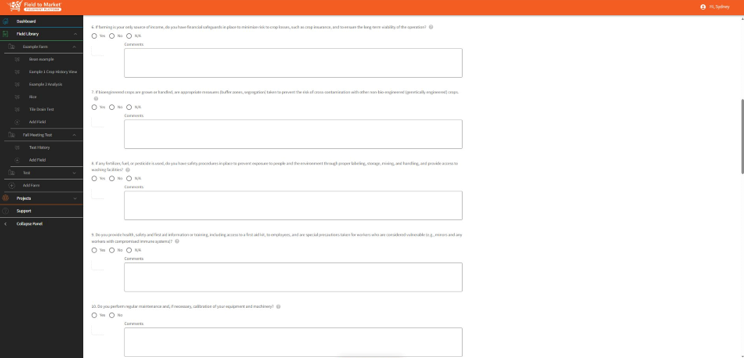
- Q6 Financial safeguards. If farming is your only source of income, do you have crop insurance or other financial resilience measures? Off-farm income or a farm with diversified revenue streams can answer N/A.
- Q7 Bioengineered (GMO) crop management. Only applies if you grow or handle bioengineered crops. If you do not, choose N/A. If you do, Yes means you have buffer zones, segregation practices, and the required permits.
- Q8 Input safety. Fertilizer, fuel, and pesticide storage and handling. Covers labeling, storage construction, mixing areas, and access to washing facilities. N/A only if you do not store any of these inputs on-farm.
- Q9 Worker health, safety, and first aid. Training, first aid kits, emergency procedures, and extra precautions for vulnerable workers. N/A is available but should only be used if you genuinely have no employees at any point in the season.
- Q10 Equipment maintenance and calibration. Regular maintenance of machinery, and calibration where applicable (especially for input application). If you use a certified pest control operator, you can reasonably answer Yes and note it in Comments.
Questions 11–15: IPM, waste, water, and manure management
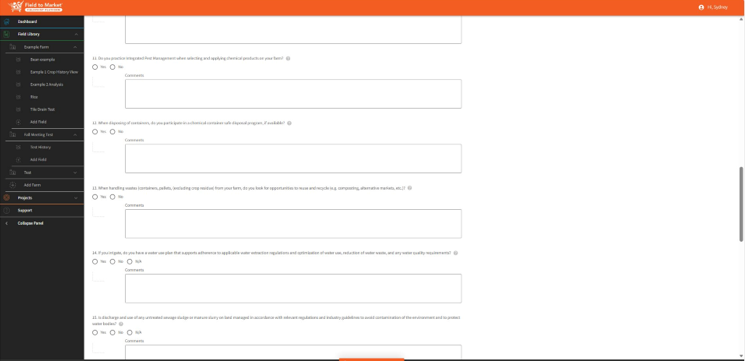
- Q11 Integrated Pest Management (IPM). Scouting, rotation of active ingredients, thresholds before spraying, and non-chemical controls where possible. Working with a Certified Crop Adviser supports a Yes answer.
- Q12 Chemical container disposal. Participation in a chemical container safe-disposal program where one is available. Yes if you triple-rinse and return or take containers to a collection event.
- Q13 Reuse and recycling of non-residue farm waste. Composting, returning pallets, recycling metal and plastic, and similar practices.
- Q14 Irrigation water use plan. Only applies if you irrigate. Dryland operations should answer N/A. If you irrigate, Yes means you have a plan that accounts for extraction regulations, efficiency, and water quality.
- Q15 Manure and sewage sludge management. If you land-apply untreated sewage sludge or manure slurry, you must do so in accordance with regulations. N/A if you do not apply these materials.
Questions 16–20: Conservation, biodiversity, and labor practices
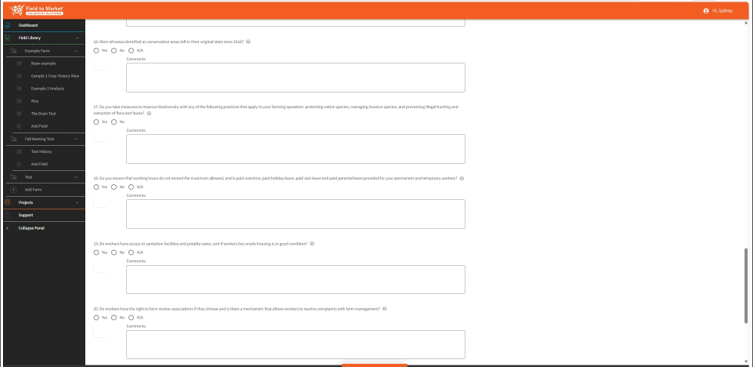
- Q16 Conservation areas. Were all areas identified as conservation areas (primary forest, mangrove, wetland, peatland, protected grassland, legal reserves) left in their original state since December 31, 2015? N/A if no such areas exist on your land.
- Q17 Biodiversity practices. Protecting native species, managing invasive species, and preventing illegal hunting or extraction. Yes/No only — no N/A.
- Q18 Working hours, overtime, and paid leave. Working hours within legal limits, plus paid overtime, holiday, sick, and parental leave as required by law. N/A only where no legal requirement exists.
- Q19 Sanitation, potable water, and onsite housing. Covers workplace sanitation and, if you provide onsite housing, the condition of that housing. N/A if no workers or families rely on farm-provided accommodation.
- Q20 Freedom of association and complaint resolution. Workers’ right to form associations and a mechanism to raise complaints with management. N/A only where government restrictions apply or no labor organizations exist in the industry.
Questions 21–22: Safety information and minors
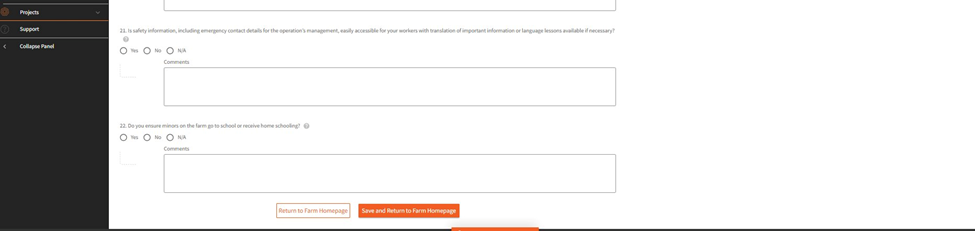
- Q21 Accessible safety information. Emergency contacts and important safety information posted in a way workers can understand, including translation or language support where needed. N/A if the entire workforce shares a primary language and ethnicity.
- Q22 Education of minors on the farm. Minors on the farm attend school or are enrolled in a recognized home-schooling program. N/A if no children work or live on the farm.
Saving and submitting
Your answers save as you fill out the form. When you finish, use the Save and Return to Farm Homepage button at the bottom. You can come back later to review or update your answers at any time before the project closes its reporting period.
What happens after you submit
Your responses feed into the project’s FSA performance result. FSA Equivalency results are reported at the project level — they are aggregated across participating growers for the reporting year. Individual grower results are not reported externally.
Your project administrator can see whether you have completed the questionnaire and will follow up if anything is missing. If a supply chain partner in the project requests verification, you may be asked to provide supporting documentation for questions you answered Yes to.